


As digital finance evolves, a crucial distinction is emerging between blockchain systems built on emerging engineering heuristics and those grounded in formal, mathematically provable security. Payment systems, especially those envisioned under the emerging PayFi paradigm, cannot rely on probabilistic assurances or ad-hoc governance. They require deterministic guarantees for settlement, integrity, and system-wide reliability. In this context, the design philosophy behind Concordium stands out. It approaches blockchain not as a loosely connected set of features, but as a layered cryptographic system whose properties can be rigorously analyzed and composed.
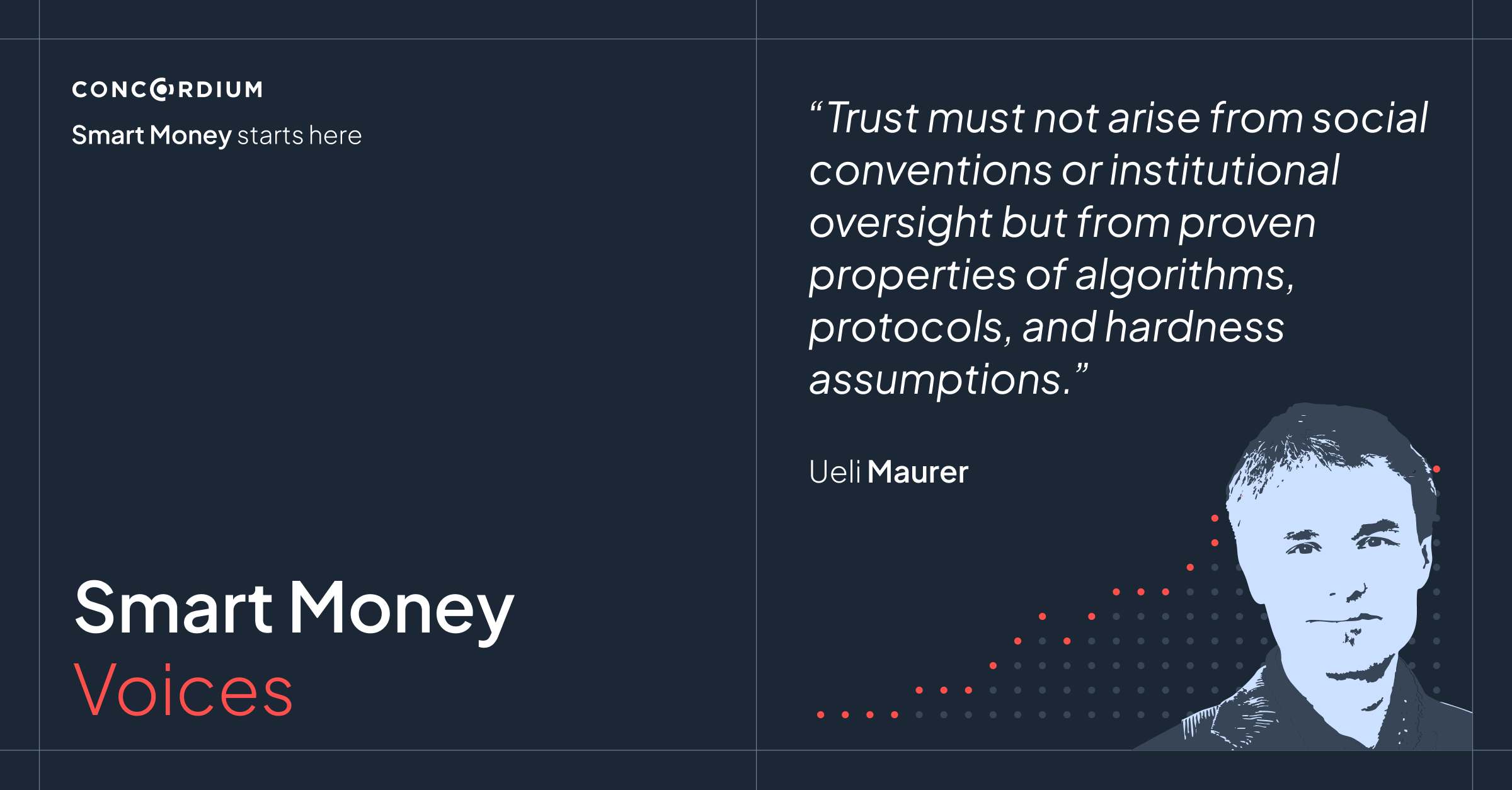
This approach is essential for an infrastructure aiming to support global-scale payments. Trust must not arise from social conventions or institutional oversight but from proven properties of algorithms, protocols, and hardness assumptions.
Consensus with Deterministic Finality
Many blockchain architectures rely on consensus mechanisms that provide probabilistic finality, whereby the likelihood of a transaction reversal decreases over time but never reaches zero. Such systems cannot offer the deterministic guarantees necessary for large-scale payments, simply because financial institutions, merchants, and regulators need absolute assurances about when funds are irrevocably transferred. If a transaction can, even in rare cases, be reorganized or undone, the system cannot meet the strict settlement, risk management, and audibility standards payment infrastructure demands.
Concordium employs a Byzantine Fault Tolerant (BFT) consensus protocol engineered to deliver deterministic finality under clearly defined adversarial thresholds. The protocol’s safety and liveness properties are formalized through standard BFT security models. This means that once a block is finalized, it becomes immutable unless a mathematically quantifiable proportion of validators behave maliciously.
From a scientific perspective, deterministic finality simplifies risk analysis: settlement risk becomes a function of protocol parameters rather than uncertain chain-reorganization probabilities. For a payment infrastructure settlement guarantees must be expressed and reasoned about rigorously. To put it more concretely, a merchant accepting a high-value payment on a probabilistic system like Bitcoin must wait for multiple confirmations as there is always a non-zero chance, however small, that a longer competing chain could appear and invalidate the transaction.
Layered, Composable System Architecture
High-value systems must support secure compositional reasoning. Concordium achieves this through a modular architecture that separates protocol layers with well-defined interfaces:
- Cryptographic Primitives: Foundations based on hardness assumptions such as discrete logarithm problems, with proof of security in standard models.
- Consensus Layer: A BFT-type protocol, derived from the HotStuff family of consensus algorithms, with proven bounds on adversarial behavior, message complexity, and fault tolerance.
- Account and Execution Model: Deterministic state transitions, verifiable smart-contract execution semantics, and resource accounting designed to avoid pathological states and emergent vulnerabilities.
- Governance Layer: Protocol update mechanics and validator incentives designed to maintain stability while enabling controlled evolution.
By adhering to clean abstraction boundaries, Concordium allows the security of the entire system to be derived from provable properties of the underlying components. This aligns with the principles of constructive cryptography, where complex systems are assembled from idealized building blocks whose behavior is precisely specified.
Such composability is rarely achieved in blockchain systems where security assumptions frequently blur across layers, creating hidden dependencies that make rigorous analysis difficult or even impossible. Concordium avoids this problem by enforcing determinism and strict modularity from the outset, ensuring each layer can be reasoned about independently, and its guarantees compose cleanly with the rest of the protocol.
Secure Execution and Predictable Computation
A payment-oriented blockchain must guarantee not only settlement but also reliable computation. Concordium’s execution environment is engineered to support: deterministic smart contract semantics, resource-bounded computation to prevent denial-of-service attacks, and verifiable state transitions derived from transparent rules.
The determinism of the execution layer enables formal verification of smart contract logic, a crucial requirement for payment applications where errors carry financial consequences. Predictable computational behavior also stabilizes transaction fees – an indispensable feature for merchant acceptance and real-time payments.
Cryptographic Rigor for Systemic Reliability
Every major security property of Concordium’s architecture–consensus, execution, validator incentive–is anchored in mathematically defined assumptions. There is no reliance on opaque trust assumptions or centralized arbiters. System reliability follows from:
- Cryptographic soundness of primitives
- BFT consensus proofs
- Deterministic state machines
- Bounded adversarial models
- Game-theoretic incentive compatibility
For large-scale payments, reliance on such formalism is not optional. A PayFi infrastructure must be able to withstand coordinated attacks,validator malfeasance, network partitions, and unpredictable user behavior. Only systems with mathematically validated components can sustain such demands while remaining transparent and auditable.
Scalable Through Mathematical Optimization
Scaling a cryptographically secure blockchain for real-world payment volumes requires more than brute-force increases in throughput. Concordium’s layered architecture enables systematic, mathematically grounded optimization, whether through more efficient aggregation of proofs, reductions in consensus message overhead, smarter batching of transactions, or improved amortization of verification costs. Because each layer’s guarantees are precisely specified, these scaling techniques can be evaluated with formal rigor. This stands in contrast to heuristic approaches, which often achieve short-term gains at the cost of introducing new and poorly understood security assumptions.
Toward A Provable Secure PayFi Infrastructure
To become the backbone of global PayFi, a blockchain has to provide fast, deterministic settlement, predictable computation, and composable security, properties enforceable by formal proofs, not institutional trust. Concordium’s consensus protocol, layer system architecture, and commitment to mathematically grounded design place it on a trajectory toward fulfilling these requirements.
The remaining work involves extending formal verification across layers, optimizing consensus and verification mechanisms for global throughput, and ensuring that protocol updates preserve all established security invariants. These challenges are scientific, not merely engineering tasks.
If the next generation of payment infrastructure is to be decentralized, it must rest on a foundation where every critical property, from finality, to integrity and correctness, is provably guaranteed. Concordium represents one of the few systems built with this principle at its core, charting a path toward a payment ecosystem grounded in provable mathematics.
About the Author
Prof. em. Dr. Ueli Maurer is Professor Emeritus of Computer Science at ETH Zurich, and one of the world’s leading cryptographers. A Fellow of the IACR, ACM, and IEEE, he has made seminal contributions to provable security, information-theoretic cryptography, and the foundations of secure system design. After retiring from teaching, he continues his research on a comprehensive constructive theory of cryptography and serves on the Concordium Foundation Board.