



Protocol 10 is live. The sender and the fee payer can be two different users.
As of block #43582381 at 10:04:23AM GMT on the 10th of March 2026, Concordium Mainnet runs on Protocol 10. The core change: transaction fee responsibility is no longer bound to the sender. A sponsor signs a separate cryptographic commitment covering the fee for a specific transaction payload.
Protocol 10 marks the tenth evolution of the Concordium blockchain, proposed, adopted, and activated by the validator network without disruption. It is the third in a deliberate sequence of infrastructure upgrades, each one building directly on the last, designed to make Concordium as the default infrastructure for real world payments.
P8 stabilised the network. P9 introduced protocol-level tokens: chain-native assets with compliance and identity built in, not bolted on through smart contracts.
P10 completes the payment experience by removing the last piece of friction that has kept Web3 from feeling like a predictable digital experience: the transaction fee.
Join the Concordium Community, follow us on X.
The Fee Problem: More Than UX
In the current model across almost every blockchain the sender always pays the transaction fee. For simple peer-to-peer transfers, this is fine. For applications targeting mainstream users, it is a significant barrier.
Consider a merchant who wants customers to pay in stablecoins. Each customer, before completing the payment, must hold a separate balance of CCD just to cover gas. That requirement has nothing to do with the purchase and for most users, it is a reason to stop.
The same friction applies to consumer apps that want to incorporate token transfers as part of their experience, and to enterprises that need predictable, auditable cost flows across high-volume token operations.
The structural problem P10 addresses is that fee responsibility sits with the user, with the added property that the sponsor's commitment is not just a business arrangement, but a verifiable, protocol-enforced obligation.
Two Signatures, Two Roles
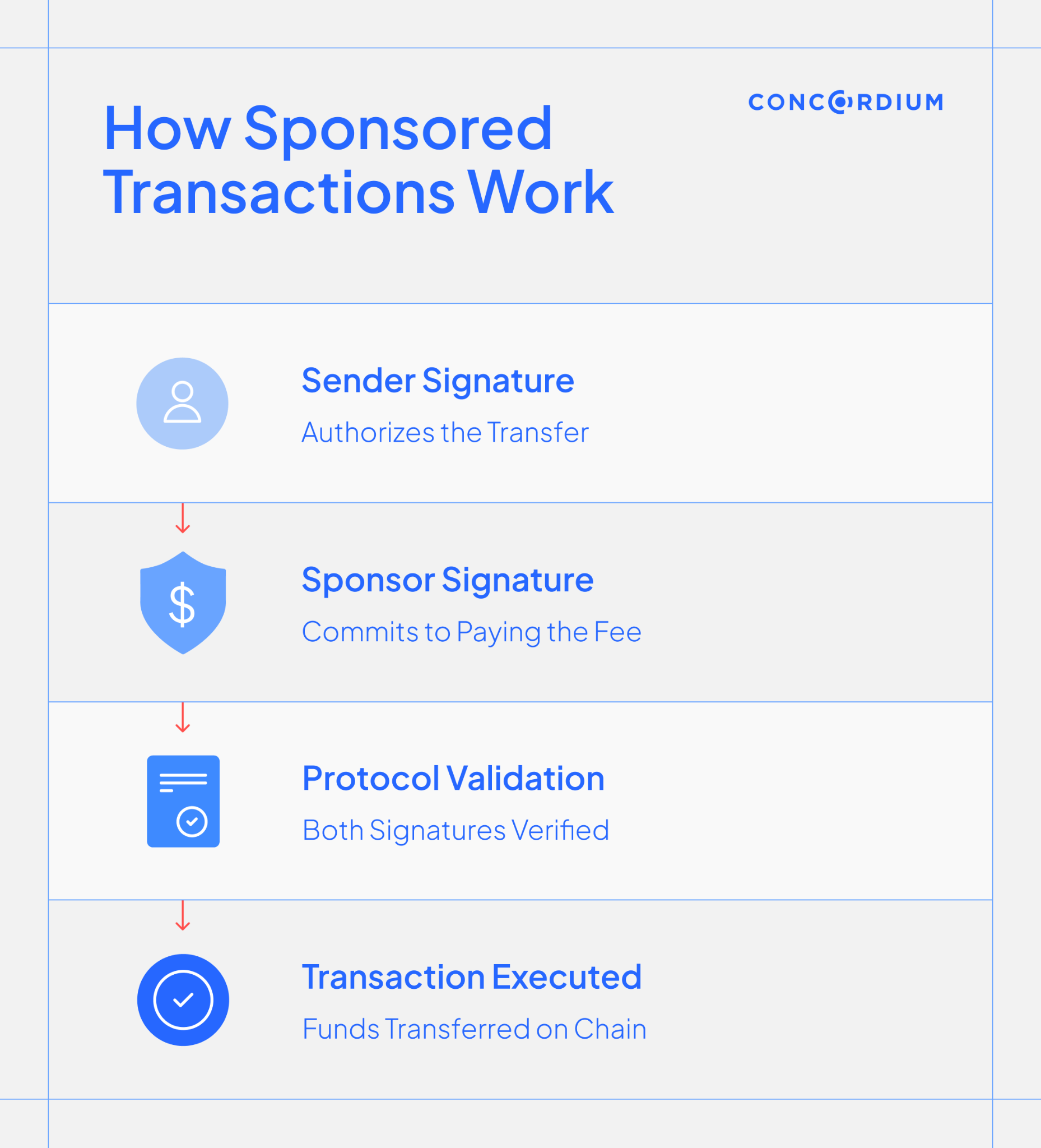
A single transaction now involves two distinct parties: the sender authorises the transfer, the sponsor commits to covering the fee. These are separate cryptographic signatures, validated independently before the transaction is accepted by the chain.
The sponsor's commitment is protocol-enforced and bound to a specific transaction payload. It cannot be detached or reused.
Concordium fees are fiat-pegged and settled in CCD, consistently in the €0.01–€0.02 range with no congestion pricing. Sponsorship can cover any network activity, not just token transfers.
- A customer pays with a stablecoin at an online store.
- They sign the payment from their wallet.
- The merchant platform sponsors the transaction fee.
- The customer never needs to acquire CCD.
Why Protocol-Level Matters
Fee abstraction exists on other chains. What makes Concordium's implementation structurally different is the identity layer underneath it.
On most networks, a sponsor covers a fee for an anonymous address. There is no context about who is transacting, no accountability beyond the cryptographic key. The sponsor is flying blind.
On Concordium, every wallet is tied to a verified real-world identity through the built-in ID layer, a design that has been in place since genesis. When a sponsor covers a fee, they are not doing so for an anonymous address. The accountability is already there. The sponsor knows, within the bounds of the system's privacy model, that the transacting party is a verified individual or entity.
This changes the risk calculus for sponsorship significantly. It makes sponsored transaction schemes viable for regulated environments including financial services, e-commerce, age-gated businesses.
The Sequence: P8, P9, P10
P8 hardened validator reliability — silent inactivity could no longer degrade finality without consequence.
P9 introduced Protocol-Level Tokens: chain-native assets with compliance controls and identity verification built into the protocol, not layered on top. Ten stablecoins across five currencies from three regulated issuers are live on Mainnet.
P10 adds the final piece: fee responsibility that sits with the sponsor, not the user. What that changes once the payer is an AI agent is covered in Who Actually Pays the Fee.
Infrastructure That Reflects How Real World Operates
In real-world payments, cost absorption is a business decision made by the party closest to the customer relationship, not a technical default imposed by the network. Card networks understood this decades ago. P10 brings the same logic on-chain, with cryptographic enforceability and identity-backed accountability that no card network can offer.
If you're building a payment flow, a consumer app, or any token-gated experience where asking users to hold CCD was the blocker — that blocker is now gone.
Want to Become a Network Validator? Run a Node and Get CCD Passively