


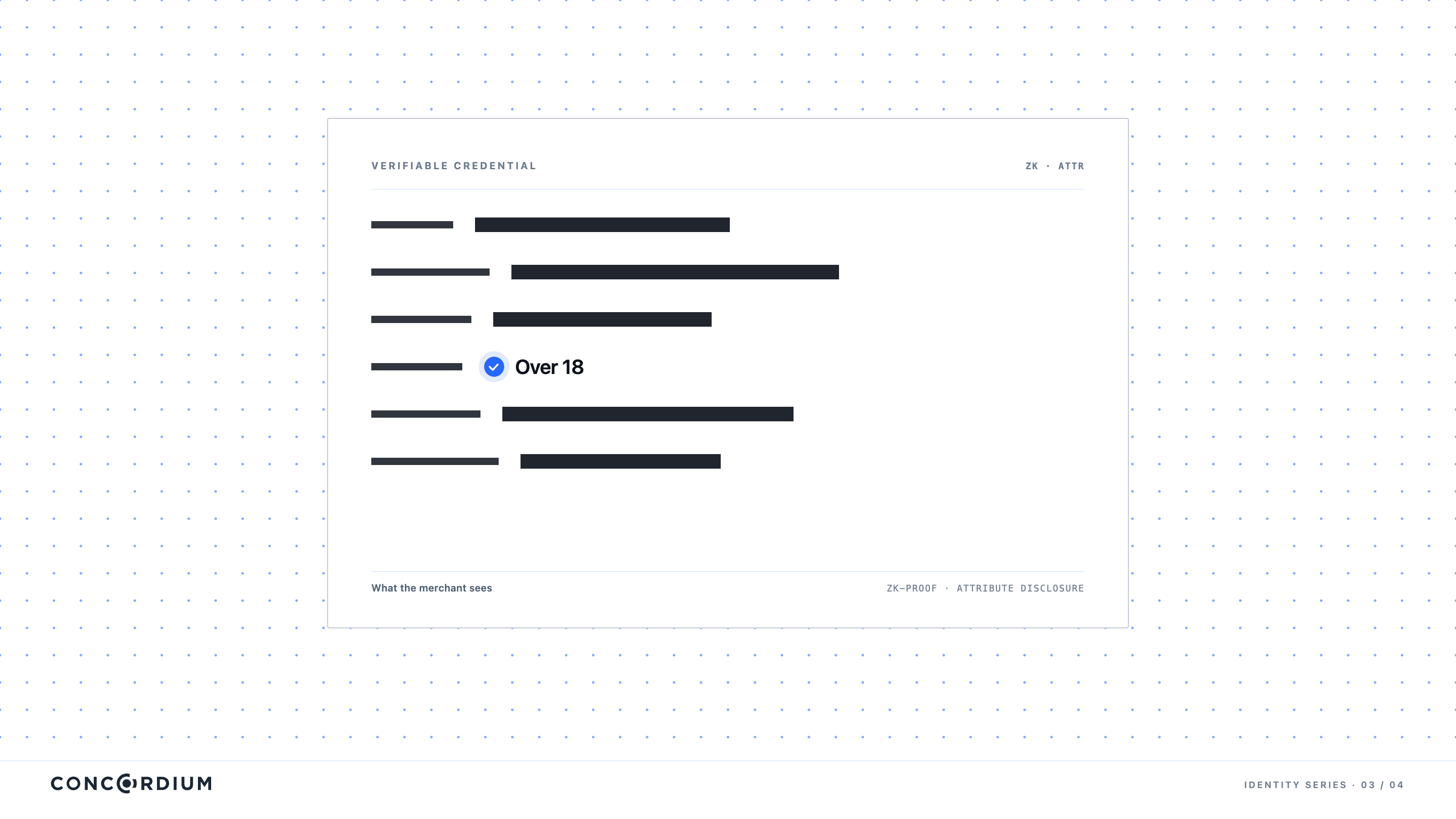
Zero-knowledge proofs (ZKPs) let users and AI agents verify age or residency status without exposing a single piece of personal data. No on-chain user data means no data is at risk.
The first article in this series explained where your identity lives after creation. The second showed how that knowledge is split across independent parties so no single one can connect who you are to what you do. This article is about what you can prove on top of that foundation without revealing anything you shouldn't have to.
New regulations and the rise of AI have created a verification problem on the internet. Platforms must verify their users while being prohibited from collecting or storing the sensitive data that traditional verification requires.
The pressure is global. The UK's Online Safety Act carries penalties of £18m or 10% of turnover. More than 20 US states have enacted age-verification laws. The EU's Digital Services Act mandates minor protection ahead of bloc-wide digital ID rollout.
And the cost of getting it wrong is visible: the reportedly 2.1 million ID photos exposed in the Discord breach, 200 millions of records stolen from Pornhub, UK adult site traffic dropping by a third when users were asked to hand over their identity. Conventional ID verification pushes personal data through multiple hands. Document scans go to third-party providers, become linkable to the individual, and databases become attractive targets for breaches. Every layer that stores your data is a layer of risk.
Concordium is not an anonymity network. It's a privacy network with accountability built in.
It was engineered around a different premise: that verified identity and personal privacy are not opposites. You can prove who you are without broadcasting it. Here's how that works in practice.
Proving Attributes Without Revealing Them
Users can share zero-knowledge proof verifications of specific identity attributes, such as being over 18 or holding residency in a particular country, without disclosing the underlying personal data that supports the claim.
No other Layer-1 blockchain offers this at the protocol level. Attribute verification on other chains, where it exists at all, depends on application-layer solutions: third-party oracles, off-chain attestation services, smart contract middleware. Each adds trust assumptions and attack surface. Concordium's ZKP verification is native. It does not sit on top of the protocol. It is the protocol.
For age-restricted platforms or jurisdiction-based access controls, this changes the equation. Auditability no longer requires full disclosure. Verification no longer requires exposure.
This is the operating principle: Verify Once. Prove Everywhere. Reveal Nothing.
That principle holds when the person presenting the proof is a human. It holds just as well when the presenter is an AI agent.
When the Agent Presents the Proof
Most verification systems were not designed with AI agents in mind. A system built around document scans breaks when the party initiating the transaction isn't a person. Either the AI agent receives sensitive data it shouldn't hold, or verification fails entirely.
Concordium's separation of credential from address, and proof from disclosure, means verified identity travels with the account, not with whoever, or whatever, is operating it. An AI agent operating through a verified wallet inherits the account's credential status without accessing the PII behind it. It presents the same zero-knowledge proofs a human would — age, residency, whatever the merchant needs.
A user wants to access three brokerage platforms across two jurisdictions. Today, that means three KYC processes, three document uploads, three databases holding passport scans. With Concordium, the user verifies once. Their AI agent approaches each broker, presenting residency proof and accredited investor status via ZKP, without the broker ever seeing the human's identity. Three brokers, one verification, zero data exposure.
The same architecture extends to AI agent identity itself. The Agent IDP issues ZKP-verifiable credentials to AI agents covering spending limits, jurisdiction, and authorisation scope verifiable without exposing the human behind them.
Benefits for Users and Merchants
Merchants gain confidence that users are verified against real documents through accredited IDPs, without taking on the liability of storing sensitive data. Users retain control over their personal information. And as AI agents become routine participants in digital commerce, the same framework extends without modification: verified, accountable, and private by design.
Age verification has long been a necessary friction. Concordium's system preserves the necessity and removes the burden. Knowing enough about someone, or about the AI agent acting on their behalf, and knowing everything about them are, by design, very different things.
But verified identity with no path to accountability is just anonymity by another name. The next article explains what happens when the system is asked to open, and why the architecture that protects privacy is the same architecture that makes legitimate disclosure trustworthy.
Join the Concordium Community, follow us on X.