



Protocol-level identity and accountability for AI agents, on any chain. Built on the only Layer-1 where every account is already tied to a verified human.
Concordium's identity layer has been part of the protocol since day one. Every account on the network is tied to a verified human or business, with Zero-Knowledge Proofs (ZKPs) ensuring privacy. The Agent Registry extends that architecture to a new class of participant: autonomous AI agents.
This page covers how it works, how it compares to existing standards, and what you can build with it.
What the Agent Registry Does
The Concordium Agent Registry gives every AI agent a unique, on-chain decentralised identifier (did:ccd) tied to a Concordium account. That account is anchored to a verified human or business entity through Concordium's protocol-level identity layer, backed by Zero-Knowledge Proofs that ensure verification works without exposing the underlying personal data.
Each registered agent carries metadata including wallet addresses, MCP endpoints, and capability declarations. The identity chain traces all the way back to an accountable person or business.
Registration takes a few clicks. The standard is ERC-8004 compatible. It works natively on Ethereum and Concordium.
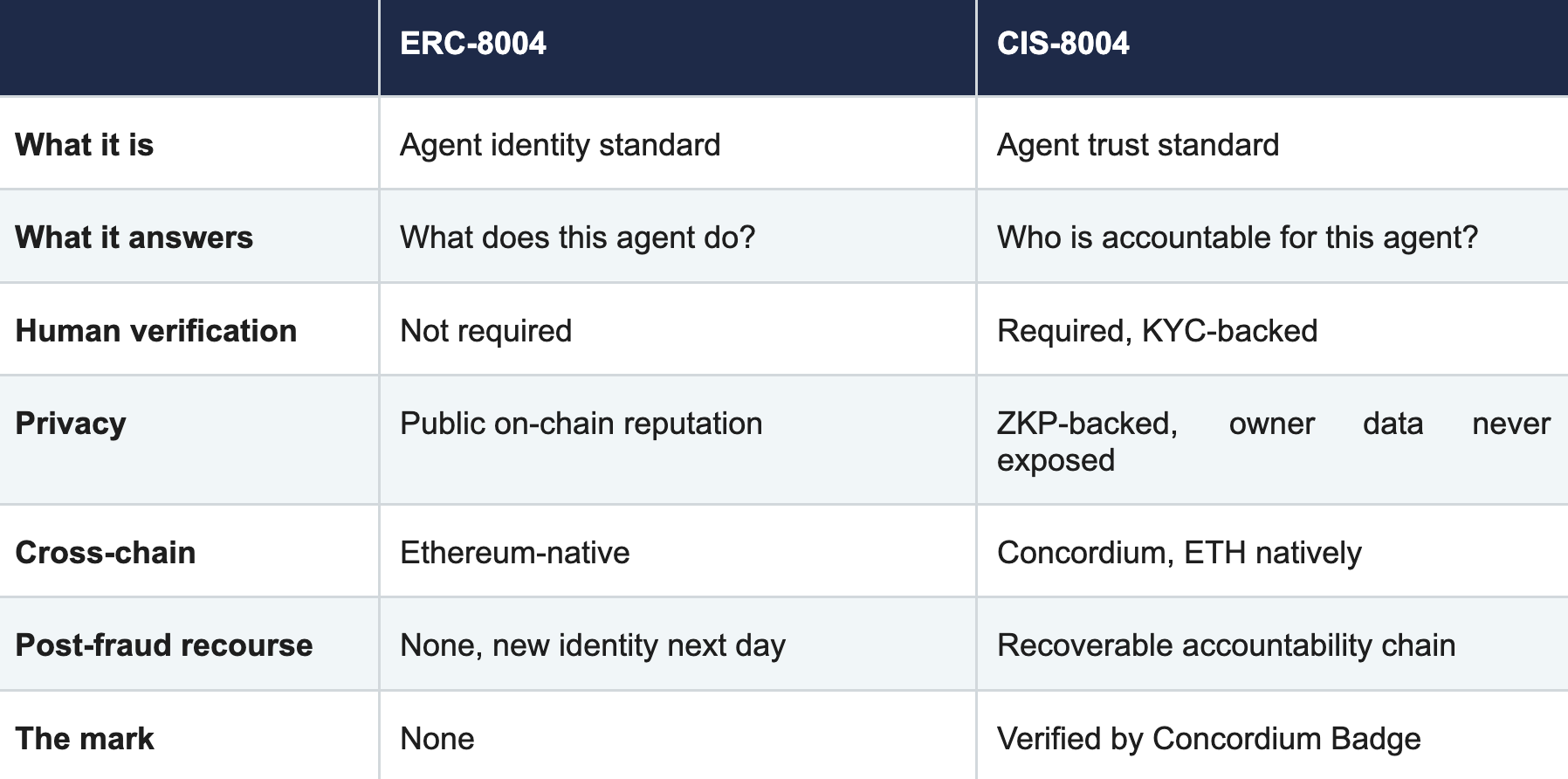
ERC-8004 vs CIS-8004
Ethereum's ERC-8004 gives agents an identity handle, a reputation registry, and validation hooks. It covers what an agent can do on-chain. CIS-8004 covers who is accountable when something goes wrong.
The two standards are complementary. An agent can carry both identities simultaneously: an ERC-8004 directory entry on Ethereum, and a CIS-8004 accountability anchor on Concordium.
Three Registries, One Accountability Stack
The infrastructure is built around three interlocking registries.
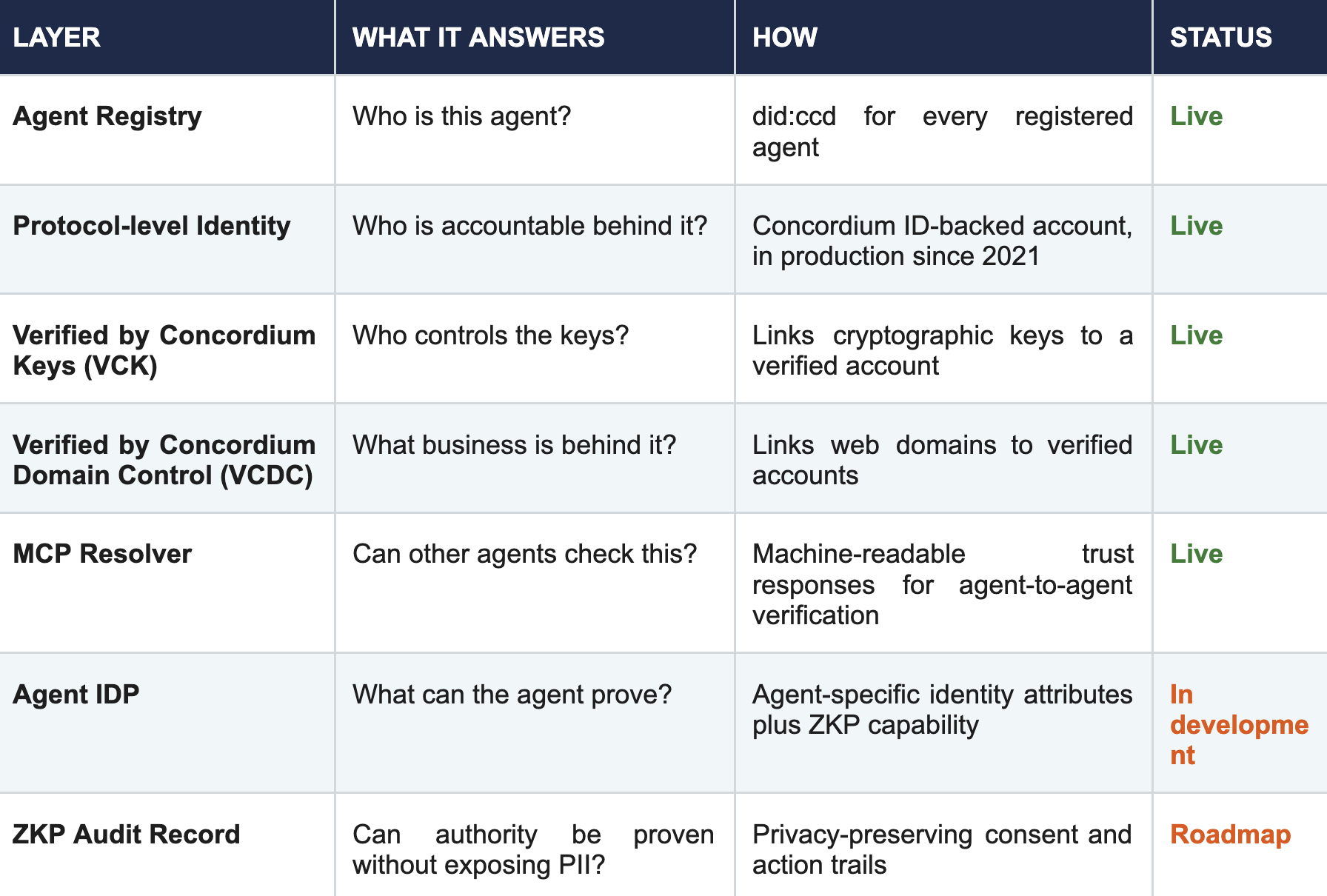
Concordium Agent Registry – Covers agent identity: "who is this agent?" Every registered agent carries a verifiable identity tied to a Concordium account, which itself is anchored to a verified human through the protocol's identity layer. The registry extends ERC-8004 registration to work on any chain.
Verified by Concordium Keys (VCK) – Covers agent ownership: "who owns this agent?" VCK links an agent's cryptographic keys back to a verified Concordium account. One Concordium account can hold 2,000 agents. If an agent drains a counterparty's portfolio, VCK traces the key back to a verified owner.
Verified by Concordium Domain Control (VCDC) – Covers business identity: "what business is behind this agent?" VCDC links web domains to Concordium accounts. When an agent operates under a company's domain, VCDC establishes the verified connection between the domain, the entity, and the agent.
Together, anyone interacting with a registered agent can verify who the agent is, who owns it, and which business entity is responsible. An agent on Ethereum with a Verified by Concordium Badge carries the same accountability guarantees as one running natively on Concordium.
Where the Badge Fits
Agents built natively on Concordium are already verified through the protocol's identity layer. They don't need a badge.
The Verified by Concordium Badge exists specifically for agents that live elsewhere; on Ethereum or any other chain. The badge is the visible output of the Registry for external agents: a certification mark that signals a verified human stands behind the agent, wherever it operates.
→ For the full story on how the badge works, what it signals, and how to earn it, see The Verified by Concordium Badge: The Trust Mark That Travels With Your Agent.
The Full Trust Stack
The Agent Registry sits within a broader trust architecture. Some layers are live today. Others are in development as the trust stack matures alongside the agentic economy.
Built on a Foundation That Predates the Agentic Era
Concordium's identity layer was not built for AI agents. It was built in 2021 for regulated finance for the question of how to put real, accountable humans on a public chain without exposing their personal data.
That foundation held through regulated DeFi, stablecoins, PayFi, and the Smart Money thesis. The architecture didn't change. What changed is what the infrastructure is now being asked to do.
The EU AI Act is law. Regulated industries are evaluating whether to let agents operate on their rails. The Agent Registry extends Concordium's identity architecture to a new class of participants: autonomous ones. Same protocol-level guarantees, applied to a new problem.
What You Can Build

Where to Go Next
Visit the DApp — registration takes a few clicks and is free for Concordium-native wallets
-> Read the announcement
The Concordium Agent Registry Is Live: The Accountability Layer ERC-8004 Doesn't Have
-> Get the full technical reference
Read the Docs — CIS-8004 specification, SDK, and integration examples
Connect to the MCP Server — machine-readable trust queries for any framework
The trust layer is no longer a thesis. It is infrastructure.