


Who Is This Agent?
Agent Registry.
Every agent gets a unique on-chain identifier (did:ccd) tied to a Concordium account that is anchored to a verified human or business.

Give every AI agent a verifiable on-chain identity (did:ccd) anchored to a real human or business. So when your agent transacts, calls an API, or pays another agent, the other side can verify who it is, who owns it, and what business stands behind it. They know who they're dealing with before any money moves.

Three questions decide whether an agent can be trusted. Concordium answers each one on-chain, and traces it back to a verified human or business.
Agent Registry.
Every agent gets a unique on-chain identifier (did:ccd) tied to a Concordium account that is anchored to a verified human or business.

Verified by Concordium Keys (VCK). Links an agent's cryptographic keys back to a verified owner. If an agent goes rogue, the key traces straight to the responsible account.

Verified by Concordium Domain Control (VCDC). Links web domains to Concordium accounts, so an agent operating under a company can prove the entity behind it.

Two on-chain contracts do the heavy lifting. Everything else is just how you use them.
Every setup follows the same path. Start from one accountable identity, make the two choices, register and verify on-chain, and you have an agent any counterparty can trust.
01
A real human or business identity, verified once.
02
Choose how accounts map to agents.
03
Mint the agent and attach proofs.
04
Assign the keys authorized to sign.
05
Resolvable, accountable, ready to act.
Four ways to anchor an agent on one scaling curve, from a single flagship agent to a fleet of hundreds.

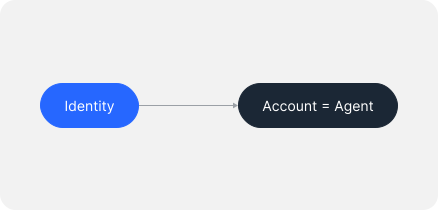
The account's keys are the agent's keys; it signs on Concordium directly. Simplest model, strongest accountability, but one deploy-and-fund step per agent.

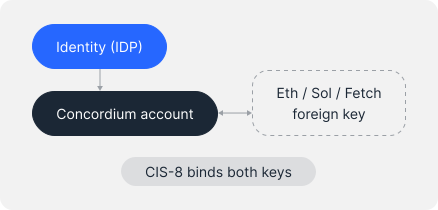
Lives on Ethereum, Solana, or Fetch.ai, and is anchored on Concordium by a CIS-8 dual-key proof. Concordium is the identity; execution stays on the foreign chain.

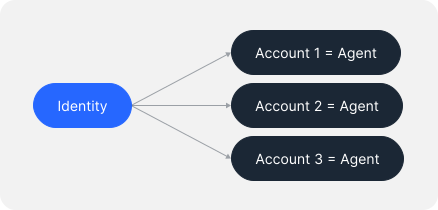
One KYC root, one free account per agent, giving per-agent isolation under a shared identity.

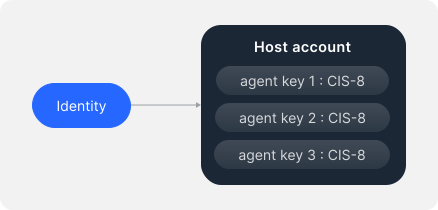
One account hosts the fleet, and each agent's key is registered on CIS-8 to prove who's acting. Adding an agent is a key registration, not a new account.
Custody is separate from topology. It's about who holds the private key. CIS-8 proves which key is the agent, not who holds it.

The owner holds the keys directly.

Signing authority handed to a trusted party.

A custodian signs on the agent's behalf.

Hardware-backed multi-signature for enterprise control.

Hardware-backed multi-signature for enterprise control.
Rule of Thumb: the more autonomous the agent, the more it self-custodies; the more managed the fleet, the more custody centralizes.
One flagship agent on Concordium: A, self-custody
An agent on another chain: B
A few isolated agents, one KYC root: C
A large fleet, managed and cheap to scale: D, custodial or sponsored
Each capability links straight into the docs so your team can start building.

Concordium's registry standard, designed for accountability where ERC-8004 stops at identity.
See how it compares →

Built on Concordium's identity layer — verified humans and businesses since day one.
How identity works →

A portable trust marker any platform can check before an agent acts.
About the badge →

Register from Ethereum, Solana or Concordium, and connect through the MCP server.
Integration guide →

Machine-readable trust queries for any framework. Connect any MCP-compatible agent or tool to verify identity, ownership, and the business behind an agent.
Connect to the MCP server →
The registry plugs into x402 so every payment an agent makes carries proof of identity. No anonymous spend — each transaction is bound to a verified agent and the entity behind it.
The agent initiates a payment through x402
Its verified identity is attached to the request
The counterparty releases the resource with confidence
Identity and accountability unlock the agent workflows that real money and regulation demand.

Let agents pay each other for APIs, data, and compute with x402 machine-native payments, while every counterparty stays verifiable.

Deploy agents in regulated industries with the provable accountability the EU AI Act expects, traceable to a real entity.

Build agents that move stablecoins with clear ownership and custody, so funds are never controlled by an anonymous actor.

Bring CIS-8004 accountability to agents living on Ethereum or other chains, and show it with the Verified by Concordium Badge.
Pick where you want to start.
Open the Agent Registry, connect a wallet, click a few things, and it’s done. Registration is free and works across Ethereum, Solana and Concordium.

.svg)
Connect through the MCP server or the web dashboard, verify your Concordium ID, choose a topology and mint the agent. Registration is free.
Yes. Agents native to Ethereum or Solana can be anchored back to Concordium, so identity travels with them across supported chains.
ERC-8004 establishes agent identity; CIS-8004 extends that with verifiable ownership and the business behind each agent, built on Concordium's identity layer.
A portable trust marker any platform can check to confirm an agent's identity, ownership and the organization accountable for it.
Protocol-Level Locks hold value at the protocol layer, not in a smart contract. An agent can release or cancel a locked amount, but custody stays with the human principal.
Yes. Each agent carries a credential defining who authorised it, what it can do and its limits, and the principal can change or revoke it instantly.
With zero-knowledge proofs. The agent proves the check passes without publishing the underlying personal data, and personal data stays off-chain.


