


.png)
World scans your iris to prove you're human. Concordium builds the identity layer that AI agents operate on. The question isn't whether you're real, but who is accountable when AI Agents act in your name.
AI broke a quiet assumption the internet was built on: that there is a real human on the other end. Generative models now write the posts, clone the voices, and pass the video calls. More than half of all web traffic is already automated. And the newest actors do not just imitate humans. They work for them. An AI Agent can hold your payment details and act while you sleep, booking the flight, paying the invoice, settling a price with another company's AI Agent.
So the question sharpens, from "are you a real human?" to "who is accountable when something acts in your name?" That move, from proof of personhood to proof of accountability, is what the agentic era forces, and it is the lens these two projects are best read through.
Two projects answer from opposite directions. Worldcoin, rebranded World in late 2024, asks you to scan your iris to prove you are a unique human. Concordium puts identity at the protocol level: you verify once through an approved Identity Provider, then prove facts about yourself with Zero-Knowledge Proofs (ZKPs) without revealing the data behind them. One model anchors itself in a live biometric scan. The other never does. Neither stores a biometric in a central honeypot, but only one makes capturing your iris the price of entry.
The Problem Both Projects Are Trying to Solve
Picture ten thousand sign-ups on a new platform overnight. Are they ten thousand people, or one person running ten thousand scripts? That question is proof of personhood: confirming an account belongs to a real, unique human, not a bot and not a duplicate.
The pressure is structural, and it is expensive. The CAPTCHA tests that once held the line increasingly fall to AI. Deloitte has projected that generative-AI-enabled fraud could reach $40 billion in the United States by 2027, up from $12.3 billion in 2023. The old human-or-bot boundary has collapsed, and the platforms that relied on it need something that still works.
So the difference between Concordium and World is not about whether to verify humans. Everyone agrees that part. The main contrast is about what you must surrender to do it: what gets collected, and whether it can ever be undone.
How Worldcoin Verifies Identity
World's method is physical. You visit an Orb, a custom device that photographs your eyes and face and turns the image into a numerical "iris code" used to confirm you have not signed up before. One detail shapes everything that follows: World's strongest proof, its guarantee that you are a unique human, comes only from the Orb. A trip, not a tap.
World has since added World ID Credentials, letting you tap an NFC passport against your phone to prove attributes like age or nationality with no iris scan; the data it reads, including the passport's facial photo, stays on your device rather than being collected by World. But that document credential is a lower-assurance, supplementary layer; the Orb's iris scan remains the anchor of World's proof of personhood.
World's privacy engineering is more serious than its critics often allow, and it deserves to be stated plainly. World says the Orb deletes the original photographs after coding. It splits the iris code into encrypted fragments across independent operators so no single party holds the whole. When a World ID is used, a Zero-Knowledge Proof confirms uniqueness without exposing identity.
But the model still rests on one irreversible act. At some point, your iris was captured by a device. Delete the image, fragment the code, distribute the storage. The system still begins with a scan of a part of your body that you cannot easily replace.
How Concordium Verifies Identity
Every Concordium account is built on Protocol-Level Identity: identity embedded in the base layer of the chain, not bolted on afterwards. Before you transact, you verify who you are once, through a regulated Identity Provider (IDP) that checks a government document off-chain and issues a credential. Your name, your document number, your photograph: none of it is written to the chain. There is no central store of personal data to breach, because the personal data was never put there. It stays with you on the device.
From that point on, you prove things without revealing them. Here is what that looks like. Prove you are over 18 without showing your passport. Prove you live in Europe without giving your address. An age-restricted retailer asks one thing, whether you are over 18, and your wallet answers with a cryptographic yes. The purchase clears. No date of birth, no document scan, no name is left on the retailer's servers to leak later. The retailer gets its assurance and carries none of the liability.
This is not anonymity, and Concordium has never claimed it is. The link between an account and a real person exists. It is encrypted, split across independent Privacy Guardians, law firms, and reachable only through a disclosure process that needs multiple parties and a valid court order. The Identity Provider knows who you are, but not what you do on-chain. The Privacy Guardians hold the keys, but not the identity behind them.
Concordium vs Worldcoin at a Glance
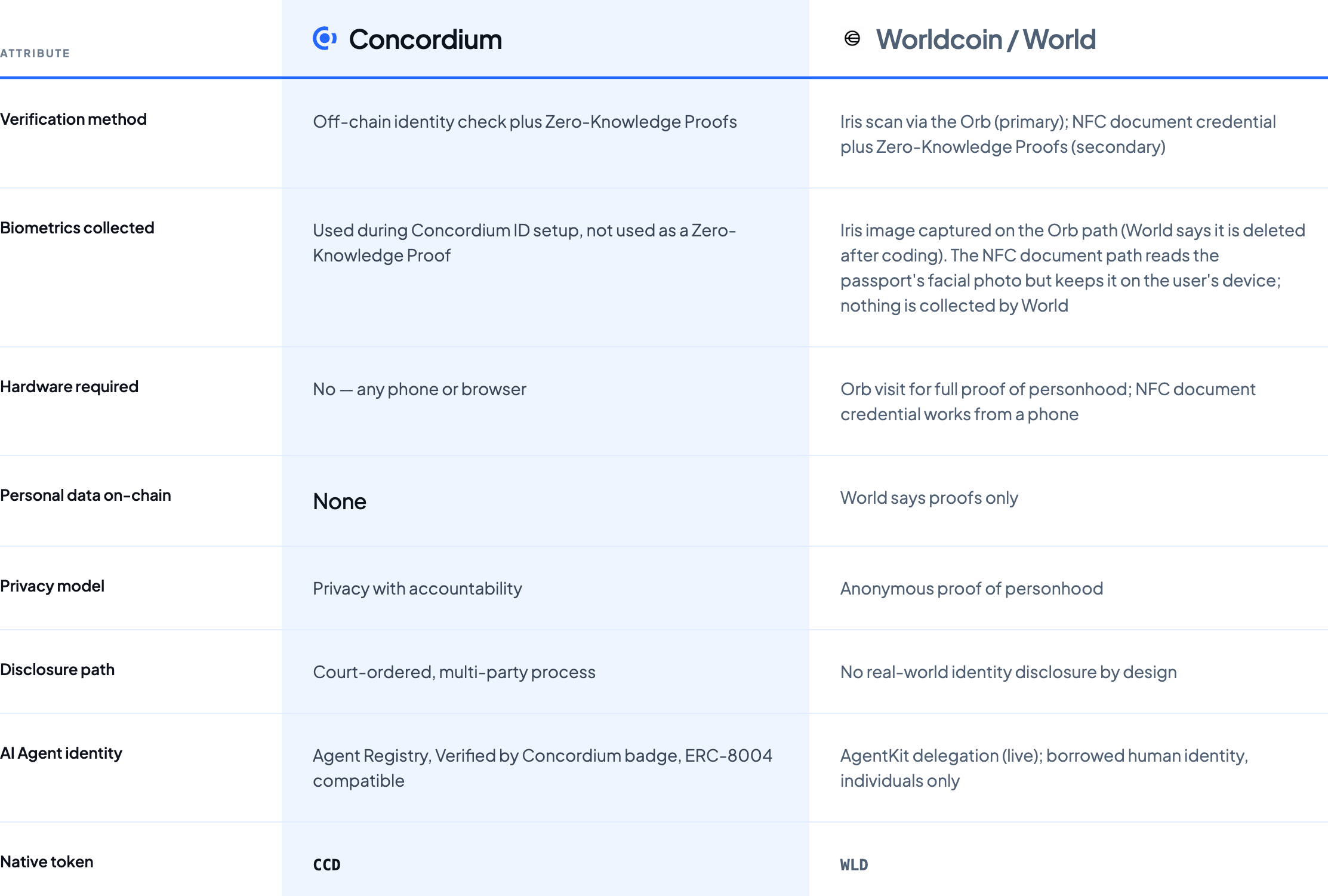
Who Is Building Each, and Where
One project was co-founded by the chief executive of a major AI company. The other grew out of a university cryptography lab. Identity infrastructure is only as trustworthy as the people and the jurisdiction behind it.
World was founded in 2019 by Sam Altman, who also runs OpenAI, with Alex Blania, who leads the developer company Tools for Humanity. The protocol is stewarded by the World Foundation, incorporated in the Cayman Islands. The same founder leads both a major AI company and the system meant to prove which actors online are human.
Concordium was founded in 2018 by Lars Seier Christensen. He co-founded Saxo Bank and ran it for more than two decades. He is an institutional operator, not a crypto-native, and that shaped what he built. His read of the industry in 2018 was that everyone was racing to build infrastructure no regulated bank could ever touch, because the architecture itself made compliance structurally impossible.
His contrarian bet was that the missing primitive was identity at the protocol level. Not application-level KYC. Not exchange-level gatekeeping. Identity built into the chain itself, with privacy preserved through Zero-Knowledge Proofs. And he did not staff it from the usual crypto talent pool. He went to academia, bringing in Ivan Damgård at Aarhus University, Ueli Maurer at ETH Zürich, and Torben Pedersen as Head Architect. Damgård co-invented the Merkle–Damgård construction behind modern hash functions; Pedersen invented the commitment scheme underneath most modern Zero-Knowledge systems.
So Concordium did not come out of crypto culture. It came out of academic cryptography meeting institutional finance. That is not a vanity detail. It means the privacy guarantees are structural, grounded in peer-reviewed work rather than a policy that can be quietly changed.
The Biometric Question: What Happens If the Data Leaks?
Biometrics belong to their own category of risk, because the data cannot be replaced. A password can be changed. A leaked card number can be reissued. An iris cannot. You cannot get new eyes. At least not under regular circumstances.
That is the structural argument against biometric identity. Even when the engineering is strong, the downside of collecting the biometric is permanent. A central store of biometric data does not lose its value to an attacker, and history is unambiguous about where that leads. A single 2015 breach of a US government database exposed 5.6 million fingerprints, with no remedy possible.
World's mitigations are real, and they narrow the exposure. But they do not remove it. World has also added a document-based credential that collects no biometric, but it is a lower-assurance add-on; the Orb's iris scan remains the anchor of World's proof of personhood, so the irreversible-collection risk stays central to the model.
The Orb is a closed device most people cannot inspect, and Vitalik Buterin has argued that this leaves a path, in theory, for the manufacturer to insert a backdoor. Deletion is largely self-reported. And the burden falls hardest on the people least able to refuse. Reporting has documented early enrolment drives concentrated in lower-income communities, paid for in tokens.
Concordium's answer is not a better safeguard. It is the removal of the central risk. Concordium stores no biometric on-chain and never makes one its proof of uniqueness. Any biometric used at the verification step stays off-chain with the regulated Identity Provider. There is no chain-level honeypot, because the chain never holds the data.
The Regulatory Test
A privacy claim is only as strong as the regulators who test it. World's model has been tested, repeatedly, and the result is instructive.
Start with the standard World has set for itself: delete the image, anonymise the code, prove uniqueness without exposing identity. Now, for the gap. Regulators keep returning to the same place, and it is not a one-off rollout problem. A German data protection regulator found the project non-compliant with the GDPR and ordered changes to how it handles and deletes iris data, a ruling World is contesting on appeal. Kenya's High Court ruled the collection unlawful, holding that paying people in cryptocurrency for a scan undermined genuine consent. Regulators elsewhere, among them Colombia, Brazil and Hong Kong, have reached similar conclusions.
The lesson is structural, not reputational. When a design begins with an irreversible biometric and pays for consent, the legal exposure begins there too.
Concordium was built from the other direction, and built for this. It runs from Switzerland, outside the major intelligence-sharing alliances, where the bar for disclosure is high by design. Disclosure is not a government request. It is not a regulatory demand. It is a court order, executed by multiple independent parties. In November 2025, Concordium joined the Age Verification Providers Association, bringing Zero-Knowledge Proof technology to the standards the industry is writing for laws like the UK's Online Safety Act. The pitch is simple: answer "is this person over 18?" without collecting or storing identity data at all.
None of this makes Concordium a privacy absolutist, and it has never pretended otherwise. You are not anonymous from a court, by design. The model depends on trusted Identity Providers holding KYC off-chain. And Concordium has, in practice, narrowed some on-chain privacy in response to regulatory feedback. These are real trade-offs. They are the price of privacy that regulators can live with, and on the current record, that is a price World has so far struggled to pay.
Identity for AI Agents: The Real Battleground
Everything above was about humans proving they are human. The harder question is the one the Agentic Economy is already asking: who is accountable when an AI Agent acts on someone's behalf?
An AI Agent can be copied, handed off, or hijacked, and every copy can spend. Picture one agent booking and paying for a holiday across a dozen sites. Each merchant needs to know a real, accountable person stands behind the spend, not a script draining a stolen card. As a16z has argued, the bottleneck for the agent economy is identity, not intelligence. It calls the missing primitive "know your agent": a verifiable link from an agent back to the human or business responsible for it.
Worth stating clearly: Concordium and World are not fighting over payments. Both plug into the same rail, x402, first built by Coinbase, Cloudflare and Stripe and now hosted by the Linux Foundation as a neutral, open agentic-payment standard. Its founding participants read like a roll call of the companies that move money online: Google, Visa, Mastercard, AWS, Microsoft and Shopify among them. That backing matters, because it means the payment layer is converging on a shared standard. The contest is one layer up, on identity. A payment tells you money moved. It does not tell you how many real people are behind the activity.
World's answer is AgentKit. A verified human delegates their World ID to an agent, and ToolRouter, a no-code layer on top, lets anyone do it without writing a line of code. It works with the MCP clients developers already use, among them Claude Code, Cursor, Codex and VS Code. World showed it live in May 2026 with a drop of 500 limited-edition hats: agents found the storefront, applied the discount and completed checkout on their owners' behalf, and all 500 went to distinct verified humans across the United States, Germany, Japan and the United Kingdom. Running more agents earned no more hats. It sits inside World ID 4.0, launched in April 2026 as "full-stack proof of human," with integrations spanning Tinder, Zoom, Docusign, Okta and Vercel. The tooling is real, and it is in people's hands.
It is a strong answer to Sybil resistance: it tells a platform how many distinct humans sit behind a group of agents. World also handles the obvious objection that one proof should not authorise everything. A service can require a fresh World ID check before an agent does something sensitive, such as publishing content or making a high-value purchase.
The difference from Concordium is architectural, not a question of who shipped what. World's model is delegation: a human lends their proof to a machine, and the agent acts on that human's World ID. Concordium starts from a different primitive. The agent is issued its own identity at the protocol level, through the Agent Registry, tied to the verified human or business behind it and carrying its own permission scope.
On top of the registry sits the Verified by Concordium badge, the trust mark for the Agentic Economy. Think of the padlock beside a secure website: one recognisable signal that a verified human or business stands behind the agent you are dealing with. Get it once, display it everywhere. And it is honest about its limits. It tells you someone verified is answerable for the agent. It does not tell you the agent will behave. The Identity Provider knows who stands behind it. Concordium does not, and the badge claims nothing more.
This is where the gap shows most clearly. ERC-8004 gives an agent an on-chain anchor: a registry entry, metadata, discoverability. What it does not give is a verified link to the human who authorised it. The agent is visible. The human behind it is a rumour. Concordium's registry is ERC-8004 compatible and adds the one thing the standard cannot supply on its own: a verified, protocol-level link to a real identity. And it cannot be retrofitted. If the base layer has no verified human identity, no contract written on top can invent one.
A few caveats. ERC-8004 is still a draft standard. The x402 rail is early. Many of the integrations announced across this field, on both sides, are still on the roadmap rather than live running at scale. No one has won this yet. But notice which model survives the move from humans to agents without changing shape. World proves a human is unique, then lets that human lend the proof to a machine. Concordium enforces identity and accountability at account creation, for whoever, or whatever, holds the account. AI Agents add a layer of autonomy. They do not remove a layer of accountability. The chain was built this way before agents were a market. That design is exactly what the Agentic Economy now needs.
Programmatic Access to Identity Attestations
An attestation is a machine-readable claim that something has been verified. Here is what that looks like: a service asks "is this a unique human?" or "is this AI Agent authorised to spend?", and receives a cryptographic proof instead of a document.
World ID offers attestations of personhood. A developer integrates the World ID kit, requests a proof, and receives confirmation that the user is a unique human. That attestation answers one question well. It confirms a human exists. It does not say who that human is accountable to, or what their software is allowed to do.
Concordium exposes attestations through the same identity layer that verifies every account. Developers request Zero-Knowledge Proofs (ZKPs) through the Concordium ID SDK: proof of age, of jurisdiction, of authorisation, each checked without revealing the data behind it. A platform confirms a user is over 18 and never sees a date of birth. Verify Once. Prove Everywhere. Reveal Nothing.
For AI Agents, the same rails apply. The Agent Registry gives an AI Agent an on-chain identity anchor with a Verified Badge, compatible with ERC-8004. The Agent IDP issues credentials the agent presents programmatically: how much it can spend, where it can operate, who authorised it. An MCP Server exposes these checks to Claude, GPT, LangChain, and Cursor, and x402 payment flows carry the verification into settlement itself.
The difference is structural. A World ID attestation proves a human exists behind the screen. A Concordium attestation links every account, human or AI Agent, to a verified identity enforced at account creation. The blockchain itself stores no personal data: the identity lives in the user's wallet and with the Identity Provider, and the chain records only an encrypted reference that can be resolved through a court-ordered legal process. The link exists. That is the point.
Which Should You Choose?
The honest answer depends on what you are building.
If you run a social or dating platform fighting bots at global scale, World is the more direct proof-of-personhood system, and it answers "how many distinct humans are here?" at real reach.
If you are an exchange, a retailer or game studio that needs privacy-preserving age verification, or any platform that cannot afford to hold a biometric honeypot, Concordium is the cleaner fit. World can now prove attributes like age too, through its NFC passport credential, but it bolts that onto a system whose core proof of personhood is still the iris scan. Concordium proves the one fact you need, whether the user is over 18 or otherwise eligible, with no biometric stored on-chain and no iris scan as the price of entry.
If you are building agentic workflows where multiple agents need independent accountability each with its own identity and permission scope, rather than shared human delegation, Concordium is the only current option with identity at the protocol layer.
The sharpest difference is not in the marketing. It is in what each system asks you to surrender before it will trust you.
Frequently Asked Questions
What is Concordium?
Concordium is AI infrastructure powered by a privacy-preserving blockchain. Every account carries a verified identity at the protocol level, so people, businesses and AI Agents can prove facts about themselves, such as being over 18, through Zero-Knowledge Proofs, without exposing the underlying data and without any iris scan.
What is the difference between Worldcoin and Concordium?
Worldcoin proves you are a unique human by scanning your iris at an Orb. Concordium proves who is accountable: it ties every account, and every AI Agent, to a verified human or business at the protocol level, using Zero-Knowledge Proofs and no iris scan. Worldcoin answers "is this a real person?"; Concordium answers "who is answerable for what this account or agent does?"
Is Worldcoin safe?
The engineering is real and has improved over time; the deeper risk is structural, not operational. An iris scan is irreversible, and regulators in Germany, Kenya, Colombia and elsewhere have found World's data practices unlawful or non-compliant, whatever the quality of the encryption, deletion and Zero-Knowledge Proofs behind it. The question is less about its engineering than about handing over a biometric you can never change.
Has Worldcoin been banned anywhere?
Yes, in several countries, though World contests many of these actions and is appealing some. It has been suspended, restricted, ordered to delete data, or penalised in jurisdictions including Germany, Kenya, Colombia, Brazil, Hong Kong, Spain, Indonesia, the Philippines, Thailand, South Korea and Argentina. A recurring finding is that paying people for iris scans can invalidate consent.
Can you use a digital identity without scanning your eyes?
Yes, with either project, though they differ in where the document sits. World added an NFC passport credential alongside its biometric Orb; Concordium is document-based by design. Concordium verifies identity using a government document, checked once by a regulated Identity Provider, then proves facts about you with Zero-Knowledge Proofs. No iris scan is required, and no name, document number or photograph is written to the chain.
Does Concordium use biometrics?
Concordium, the AI infrastructure, never collects or stores biometrics, but the one-time identity check that happens off-chain sometimes does. Verification is handled by a regulated Identity Provider, and depending on the provider and document, that step can involve a biometric such as a selfie or liveness check to confirm the document is really yours. One Concordium onboarding route in Africa, for instance, lets people verify with a national ID number and a selfie. That biometric stays with the Identity Provider; Concordium never sees it, and no biometric, name, document number or photograph is written to the chain.
Can Concordium reveal who I am?
Only under a valid court order, and never by Concordium acting alone. The encrypted link between an account and a verified identity exists, but it opens only through a legal process executed by multiple independent Privacy Guardians together. Privacy with accountability, not anonymity.
What is the difference between Worldcoin and Concordium for AI agents?
Both tie an AI Agent back to a verified human; they differ in how they scope that link and who can stand behind it. World's AgentKit lets a verified human delegate their World ID to an agent, so the agent proves a real, unique human authorised it. That keeps the model simple and is strong for Sybil resistance, telling a platform how many distinct humans sit behind a group of agents. Concordium's Agent Registry, which is ERC-8004 compatible, also has the agent inherit identity from the verified party behind it, but that party can be a business as well as an individual, and each agent's permission scope can be adjusted, covering what it is allowed to do and how much it can spend. Both reveal the real identity only through a court-ordered process. The right fit depends on whether you mainly need to count unique humans or to give individual agents their own adjustable, accountable scope.
Can developers verify identity attestations programmatically?
Yes. World ID provides a developer kit that returns proof a user is a unique human. Concordium goes further: the Concordium ID SDK and MCP Server let developers request Zero-Knowledge Proofs about humans and AI Agents alike, covering age, jurisdiction, spending authority, and the accountable human behind an agent, without ever receiving the underlying personal data.
—
Identity came first. Payments came second. AI Agents are arriving now.
That order matters. A payment can show that money moved, but it cannot show who should answer for the action. A proof of personhood can show that a unique human exists, but it does not automatically create an accountable relationship between that human, an agent, and a transaction.
That is where the two models separate.
World answers the question: is this a unique human?
Concordium answers the question the agent economy is starting to ask next: who is accountable when software acts?
As AI Agents begin to transact across platforms, sign permissions, spend funds, and negotiate with other agents, identity cannot sit beside the system as a patch. It has to sit underneath it.
That is the bet Concordium made early: verified humans, verified businesses, and verified AI Agents operating on the same identity layer, with privacy by default and accountability when the law requires it.
The internet is no longer just asking whether someone is real.
It is asking who stands behind the action.
Verified Humans. Verified Agents. One Protocol